Circles
The circle is the first and most important construction in ruler‑and‑compass geometry. Once the radius is set, every point on the circle is the same distance from the centre. This single idea generates an enormous amount of structure: alignments, intersections, symmetries, and the beginnings of patterns that appear across many craft traditions.
Circles are not just shapes. They are tools—a way of marking equal distances, finding relationships, and revealing order.

What a Single Circle Gives You
A single circle establishes a centre, a radius, a boundary, and a reference for symmetry. It becomes the anchor for almost every construction that follows. Many geometric systems begin with nothing more than a point and a circle.
- a centre
- a radius
- a boundary
- a reference for symmetry
Two Circles: The Vesica and First Intersections
When a second circle is drawn with the same radius, centred on the circumference of the first, something important happens. The circles intersect in two points, those points define vertical alignment, and the overlapping region—the vesica piscis—appears. The geometry of equilateral triangles emerges automatically.

Two equal circles defining the vesica and first intersections.
Three Circles: The Seed of the Hexagon
Adding a third circle, again with the same radius, creates the six points of a perfect hexagon and a natural triangular grid. This is the basis of many pattern traditions: stars, tilings, and frameworks that appear in manuscripts, architecture, and decorative arts.
Six Circles Around One: A Complete Unit
Placing circles at each new intersection produces a ring of six circles around a central one. From this simple arrangement, you can derive hexagons, equilateral triangles, six‑pointed stars, sub‑grids, and rotational symmetries. It is a quiet but powerful generative system.
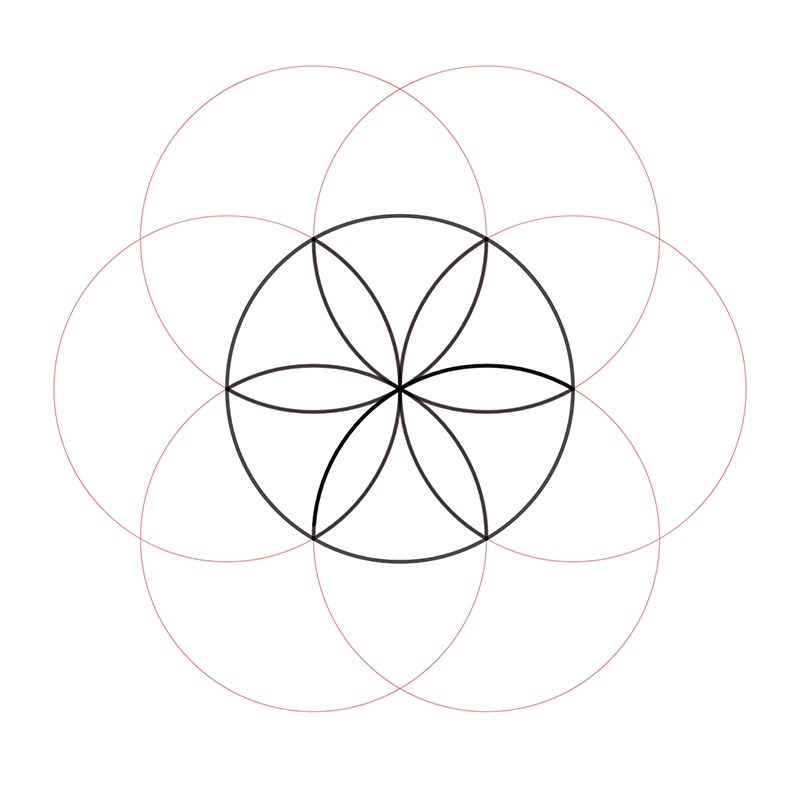
Six circles around one—hexagons and stars hidden inside.
Why These Constructions Matter
Circles are not just the first step—they are the organising principle behind many geometric traditions. By working with equal circles, you avoid measurement and rely instead on relationships. You discover structure rather than impose it, and you begin to see the underlying order in complex designs.
Step‑by‑Step: Drawing the First Circle
- Place the compass point on the chosen centre.
- Set the radius by opening the compass to the desired width.
- Hold the compass lightly but steadily at the centre.
- Rotate the pencil around the centre in a smooth arc.
- Keep the radius constant throughout the movement.
- Complete the circle in one continuous motion if possible.
Notes for Practice
- Work slowly; steadiness matters more than speed.
- You don’t need full circles—arcs are often enough.
- Try drawing two equal circles and explore the intersections.
- Build the six‑circle ring and notice how much structure appears automatically.
You must be logged in to post a comment.